Dataset · Aalto University
Ambient Intelligence group, Department of Information and Communications Engineering, Aalto University, Finland; Xujun Ma: Southeast University, China. * Equal contribution.
Overview
Participants performed hand and arm gestures, daily activities, and expressions of six affective behaviors while 13 mmWave radars, a LoRa link, passive RFID tags on the arms, body-worn IMUs, and a 24-camera infrared motion-capture system recorded them at the same time. The motion capture gives the reference of body motion for every radio-frequency signal.
13 TI IWR1443 mmWave radars (77–81 GHz). Point clouds of moving reflections: time, x, y, z, signal strength. About 30 frames/s on the ground, 5–7 on the ceiling.
node r · all radars of a trial in one zipSemtech SX1276 node and USRP receiver at 865.5 MHz. Amplitude of the baseband signal at 200 Hz, its difference, and its variance at 20 Hz.
node 5 · next to radar 5Six passive Alien tags on the arms (wrist, below and above the elbow), read by an Impinj Speedway R420. Time stamp, tag, RSSI, and phase of every read.
node 13 · antenna on radar 524 infrared cameras at 100 Hz. Position and rotation of the rigid bodies of the suit: chest, arms; in activities and affective behaviors also hips and legs.
node 14 · reference of body motionMovesense sensors on the chest and the limbs at 104 Hz: acceleration, angular rate, magnetic field.
node x · body-wornSeven participants of the living room repeated the affective-behavior protocol with a Shimmer3 ExG ECG (four electrodes, 512 Hz) and a NeuroSky MindWave Mobile EEG (one channel, 512 Hz, with band powers and eSense scores at 1 Hz), next to radar and IMU.
node x · body-worn · folders ecg/ eeg/Setup
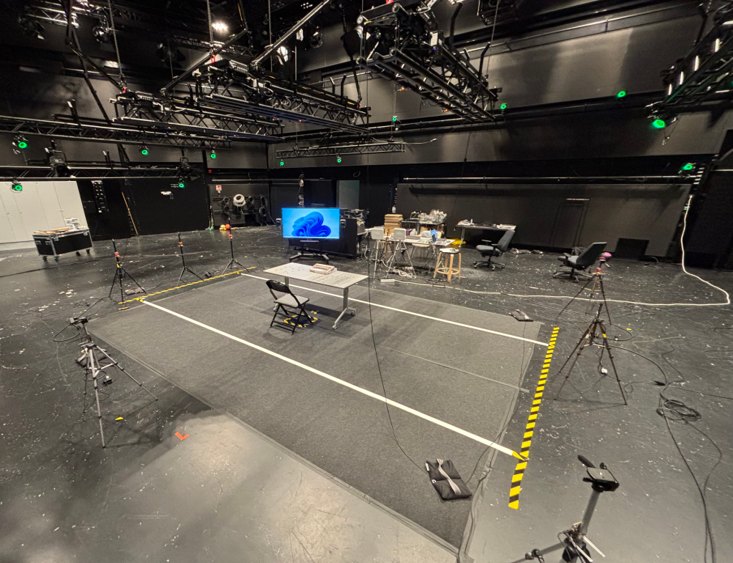
For the gestures (C1 and C4) the participant stands at the centre of a circle of eight ground radars
(radius 1.5 m, height 1.3 m, every 45°). For the activities and the affective behaviors (C2 and C3) the
ground radars surround a 6 m × 2 m area: radars 5 and 9 at the short ends, 6, 7, 8 and 10, 11, 12 along the
long sides, about 0.9 m high. Five more radars look down from the ceiling in both layouts. The LoRa
antenna and the RFID antenna sit next to radar 5. The motion-capture frame has its origin at the centre
of the area; meta/nodes.csv holds the measured radar positions of both layouts.
| Campaign | Classes | Length |
|---|---|---|
| C1 gestures | 21 hand and arm gestures (raise, push, pull, swipe, throw, circles, …) | 3.5 s |
| C2 activities | walking, running, sitting, lying, stairs, basketball, badminton, floorball, football | 6 s |
| C3 affective behaviors | focus, distraction, stress, relaxation, depression, excitement | 2.5 min |
| C4 gestures at antenna distances | the 21 gestures of C1, RFID only; the antenna at 1.5 m or 3 m, in front or at the side | 1.5 s |
The ceiling radars were 5 m high for the first 16 participants of C1 and 3 m high afterwards; the trial table records the height of every trial.
Data
The release has flat folders and one zip for each trial and modality (the file convention of the
OctoNet dataset), named <node>_<modality>_<environment>_<user>_<class>_<repetition>_<time>.zip.
The zips of a trial share the same time stamp.
radar/   r_radar_1_1_M10_1_20250710163420.zip    radar_00.npz … radar_12.npz
lora/    5_lora_1_1_M10_1_20250710163420.zip     abs_200Hz.csv, diff_200Hz.csv, var_20Hz.csv
rfid/    13_rfid_1_1_M10_1_20250710163420.zip    rfid.csv   (C4 antenna positions 15, 16, 17: rfid_15/ rfid_16/ rfid_17/)
mocap/   14_mocap_1_1_M10_1_20250710163420.zip   mocap.csv
imu/     x_imu_1_3_E01_1_20250720180733.zip      Chest_acc_data.csv, Chest_gyro_data.csv, …
ecg/     x_ecg_2_62_E01_1_20261002152433.zip      ecg.csv
eeg/     x_eeg_2_62_E01_1_20261002152433.zip      raw_eeg_512hz.csv, summary_1hz.csv
meta/    trials_Lab.csv, trials_LivingRoom.csv, trials_Industry.csv, participants.csv, self_assessment.csv, classes.csv, nodes.csv
scripts/ readers, loader, download and unpack scripts, demo notebook| Environment | Modalities | Participants | Trials | Zips |
|---|---|---|---|---|
| 1 laboratory | radar, LoRa, RFID, motion capture, IMU (C3); C4 RFID only | 44 | 17,030 | 36,060 |
| 2 living room | radar, IMU; plus ECG and EEG for a physiological reference subset of 7 participants (34 phases) | 17 + 7 | 2,172 + 34 | 4,339 + 136 |
| 3 industrial site | radar, IMU | 9 | 1,182 | 2,359 |
| Total | 61 | 20,384 | 42,894 (1.9 GB) |
Note: the laboratory IMU recordings of C1 and C2 are not uploaded yet, because of a technical issue we faced during the data collection. We will upload them once the issue is solved.
| Participants by age range | Women | Men | All | Laboratory | Living room, industrial site |
|---|---|---|---|---|---|
| under 18 | 1 | 2 | 3 | 3 | 0 |
| 18–20 | 2 | 1 | 3 | 2 | 1 |
| 21–30 | 19 | 25 | 44 | 35 | 9 |
| 31–40 | 5 | 0 | 5 | 2 | 3 |
| 41–50 | 2 | 2 | 4 | 2 | 2 |
| not recorded | 2 | 0 | 2 | 0 | 2 |
| All | 31 | 30 | 61 | 44 | 17 |
Gender, age range, shoulder width, head-to-shoulder distance, arm length, and the campaigns of every participant
are in meta/participants.csv; the self-ratings after each C3 state (0 to 5) in meta/self_assessment.csv.
Gender and age of the 7 participants of the physiological reference subset were not recorded.
| Segments (one per trial and modality; one per radar file) | Total segments |
|---|---|
| C1 gestures | 66,167 |
| C2 activities | 31,943 |
| C3 affective behaviors | 2,258 |
| C4 gestures at antenna distances (RFID) | 10,620 |
| Living room (radar files, IMU) | 26,947 |
| Industrial site (radar files, IMU) | 13,880 |
| Total | 151,815 |
The trial table meta/trials_Lab.csv has one row per trial: participant,
class, repetition, reference time, ceiling height, and for every modality its presence, start, duration,
and extra facts. A Python loader and a reader with figures for every modality ship with the data.
Compatibility note: the loader uses the same calls as the loader of the
OctoNet dataset (get_dataset,
get_dataloader), so code written for OctoNet runs on RF-Behavior with few changes.
Explore
This page reads the release zips and draws them here, with the same transforms as the reader scripts: the radar point cloud in the room, the LoRa features, the motion of the RFID tags, the motion-capture skeleton, and the IMU signals. The sample trials come with this page. With your own Hugging Face read token the page reads any trial of the whole dataset straight from the Hub. Nothing is sent to a server of ours.
Accept the terms on the dataset page, then make a read token under Settings › Access Tokens. The token stays in this browser and goes only to huggingface.co. C4 (RFID at antenna distances) has no view here.
Gallery
Figures made by the reader scripts of the dataset. Pick an environment, a campaign, a class, a modality, and a view. Radar views can show all radars or the ground radars only.
Download
The dataset is released under CC BY-NC-SA 4.0 for non-commercial research. Access is gated: accept the terms on the dataset page, and access is granted at once. Then:
hf auth loginpython download_rfbehavior.py --campaign C1 --user 1 3 4 \
--modality radar lora --out ./RF-Behavioror with the Hub library:
from huggingface_hub import snapshot_download
snapshot_download("Si-Z/RF-Behavior", repo_type="dataset",
    local_dir="RF-Behavior",
allow_patterns=["meta/*", "radar/r_radar_1_1_M*"])from rfbehavior_loader import get_dataset, get_dataloader
config = {"environment": [1], "campaign": ["C1"],
"node_id": [5, 6, 7],
"modality": ["radar", "lora", "rfid", "mocap"]}
dataset = get_dataset(config, "RF-Behavior")
sample = dataset[0]
sample["class_name"] # 'arms swing'
sample["modality_data"]["radar"][5]["points"]
loader = get_dataloader(dataset, batch_size=4)A stand-alone demo folder, demo
on GitHub, downloads a selection with a config.json and draws it in a notebook (same calls as the
OctoNet demo).
To draw a trial with the reader scripts, put the download into the recording layout first:
python unpack_release.py --download ./RF-Behavior --out ./RF-Behavior_unpacked
python Radar/read_vis.py --root ./RF-Behavior_unpacked/Lab/Radar     --view animation --campaign C2 --user U01 --cls A01
Cite
Si Zuo, Yuqing Song, Jin Han, Sahar Golipoor, Ying Liu, Xujun Ma, Petter Holme, and Stephan Sigg. RF-Behavior: A Multimodal Radio-Frequency Dataset for Activity and Affective Behavior Analysis. arXiv:2511.06020. A revised version is under final review at IMWUT.
@article{zuo2025rfbehavior,
title = {RF-Behavior: A Multimodal Radio-Frequency Dataset for Activity and Affective Behavior Analysis},
author = {Zuo, Si and Song, Yuqing and Han, Jin and Golipoor, Sahar and Liu, Ying and Ma, Xujun and Holme, Petter and Sigg, Stephan},
journal = {arXiv preprint arXiv:2511.06020},
year = {2025}
}Contact: Si Zuo, Aalto University, si.zuo@aalto.fi.